




EDITOR'S NOTE: Parathyroid cancer is EXTREMELY RARE. This page on parathyroid cancer is included on Parathyroid.com so that all aspects of parathyroid disease are covered on this large Web site. Do NOT make parathyroid cancer the only information on parathyroid disease that you read about. If you do so, you will not get an accurate picture of what parathyroids are, what parathyroids do, and what parathyroid disease is all about. We strongly suggest that you read other aspects of parathyroid disease first, and never read about parathyroid cancer. Parathyroid disease is only fairly common, but parathyroid cancer is extremely rare. Once again, If this is the first page of this site you have seen, go to parathyroid overview first.
Almost all parathyroid problems are caused by one or more of the parathyroid glands producing too much parathyroid hormone (PTH). This is called hyperparathyroidism and it causes a number of medical problems such as osteoporosis, mental disorders, ulcers, pancreatitis, kidney stones, and other symptoms. However, the overgrowth of parathyroid tissues responsible for this overproduction of parathyroid hormone (PTH) is NOT malignant and therefore they are usually referred to as parathyroid adenomas (benign parathyroid hormone secreting tumors). In other words, the typical patient with parathyroid disease has a benign tumor of one of their parathyroid glands.
Parathyroid disease is caused by a single bad parathyroid gland (a benign parathyroid tumor) about 75 - 80% of the time. Since there are 4 parathyroid glands, removing one bad one becomes the simple way to cure the problem. This is true even if its cancer... (but it almost never is!). The other 20% of patients have two or three bad parathyroid glands. Rarely people get all four bad parathyroid glands.
Parathyroid glands are no different than every other tissue in the human body--they can develop cancer in them. Parathyroid cancer, however, is extremely rare, with only a few dozen cases seen every year in the US. Parathyroid cancer is so rare, that most doctors have never seen it. Editorial note from Dr. Norman: We operate on about 3,500 patients per year with parathyroid disease (more than 70 per week), with patients coming from all over the U.S. and many foreign countries. Even with this volume of parathyroid patients, we only see one case of parathyroid cancer about once every 6 years. It is so rare, that you should not be reading about it. If our patients ask about parathyroid cancer, we will not discuss it with them, telling them that we won't waste time talking about something that almost never happens. We do not ever discuss parathyroid cancer with our patients before their operation, because they don't have it, and with near 100% certainty, neither do you.
Very rarely, a parathyroid gland will become cancerous (the overgrowth is composed of malignant cells). Since parathyroid cells make parathyroid hormone (PTH) as their only purpose in life, those that are cancerous (growing out of control) will make PTH "out of control" as well. In fact, that is a big tip-off that a patient with hyperparathyroidism might have parathyroid cancer since these malignant tumors will produce "massive" amounts of parathyroid hormone instead of "large" amounts like are seen with benign parathyroid tumors (adenomas or hyperplasia). All patients with hyperparathyroidism have elevated parathyroid hormone in their blood, those with benign disease tend to have levels in the "hundreds" where as those with parathyroid cancer tend to have values in the "thousands". This is a generalization and you know what that means... not always true. Parathyroid cancer, parathyroid Parathyroid cancer parathyroid cancer, parathyroid disease causes high calcium. Parathyroid surgery for parathyroid operation parathyroid cancer, parathyroid cancer treatment of parathyroid cancer.
Facts About Parathyroid Cancer
- Parathyroid Cancer is very rare: about one case in every 8000 patients with parathyroid disease, or possibly even rarer! So... you don't have it! We haven't seen a single case of parathyroid cancer in our last 8,000 patients we have operated on.
- Most cases of "parathyroid cancer" that are sent to our center are told after we review their case that they do not have parathyroid cancer. The vast majority of "parathyroid cancers" are not cancers, they are just old tumors that were not removed in a timely fashion, and then an inexperienced surgeon didn't recognize this fact. In our estimate, 90% of the cases of "parathyroid cancers" are not cancer, they are old tumors that are confused with parathyroid cancer.
- As of February 2017, Dr Norman and his team at the Norman Parathyroid Center have treated over 33,000 people with parathyroid disease yet they has seen only 4 cases of parathyroid cancer.
- Parathyroid Cancer is can be mild, and not very aggressive. In other words, parathyroid cancer is not expected to cause death to the patient.
- Parathyroid Cancer is often hard for the pathologist to diagnose under the microscope. Thus the diagnosis often depends on the clinical picture (very high parathyroid hormone levels, and very high serum calcium levels). However, essentially 100% of people with very high levels just have an old parathyroid tumor, NOT cancer.
- Parathyroid Cancer is usually associated with extremely high parathyroid hormone (PTH) levels (typically in the thousands). But not always.
- If your parathyroid hormone level is not in the thousands, and your calcium in not consistently over 14, you do not have parathyroid cancer (a generalization, but a very good one).
- Although people are told that very high calcium levels are often parathyroid cancer, this is not the case. Almost all people with calcium levels above 14 still do not have parathyroid cancer... they just have a big, old, benign tumor that has been present for a long time (and should have been removed long ago).
- Parathyroid cancer is usually associated with extremely high blood calcium levels (over 14 or 15). The "massive" amounts of parathyroid hormone mobilizes huge amounts of calcium from the bones, releasing this calcium into the blood stream. However, if your calcium is above 14, you do NOT have parathyroid cancer... you have an old tumor that should have been removed years ago (isn't this redundant?).
- Parathyroid Cancer is occasionally associated with a genetic defect, therefore, parathyroid cancer can run in families (a MEN Syndrome--use the search tool on this site to find pages on MEN Syndromes).
- Like most cancers, the chance of cure from parathyroid cancer is highest if found and treated early... By a surgeon who knows what he/she is doing! Please, no joe-blow surgeon down the street for this!
- The prognosis of parathyroid cancer depends on whether the cancer is contained within the parathyroid gland or has spread (metastasized) to other areas (lymph nodes, lung tissue, etc).
- Parathyroid cancers can reappear as long as 30 years later, so patients with parathyroid cancer must be examined at least yearly for many years... that is, they need their calcium and PTH levels checked yearly. Those patients with benign parathyroid tumors (almost everybody) never need to have their blood calcium checked again after the first post-op visit.
- Since parathyroid cancers typically make huge amounts of parathyroid hormone (PTH), the effectiveness of the original operation to remove all the cancer can be examined by measuring serum parathyroid hormone levels post-operatively (note: these very high levels often will take several months to come down to normal after a successful operation).
- The amount of parathyroid hormone in the blood should be determined regularly for years to determine if the parathyroid cancer is recurring (coming back). (This is NOT true for ordinary hyperparathyroidism patients which had their disease because of an overgrowth of benign parathyroid tissues---adenomas and hyperplasia).
- Serum calcium levels should also be followed at regular intervals for years postoperatively since they will rise in response to rising parathyroid hormone levels should the parathyroid cancer return.
- Radio-guided parathyroid surgery works extremely well for parathyroid cancer. Radioguided techniques (the MIRP Operation) should be used for patients with parathyroid cancer--to help the surgeon know if there are any lymph nodes in the neck that have metastatic parathyroid cancer, and to let the surgeon know when all of the parathyroid tumor has been removed from in and around the thyroid gland.
- Parathyroid cancer is like all other parathyroid problems--if you want to be cured, you must have an excellent surgeon for the FIRST operation. You wouldn't believe the stuff we see every day. Parathyroid surgery is not for your local general surgeon or ENT surgeon!
PARATHYROID CANCER TREATMENT OVERVIEW
There are treatments for ALL patients with parathyroid cancer. Two kinds of treatment are used: surgery (surgical removal of the parathyroid cancer and any nearby tissues which are affected), and radiation therapy (using high-dose x-rays to kill cancer cells). Chemotherapy (using drugs to kill cancer cells) is being studied in a few clinical trials, but there have been no good chemotherapy drugs identified as effective up to this point.
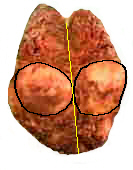 Surgery is the most common and by far the best treatment for parathyroid cancer. Treatment for parathyroid cancer depends on the size of the tumor, its location, and whether or not it has spread to other tissues. The parathyroid gland (parathyroidectomy) and the half of the thyroid on the same side as the cancer (thyroid lobectomy) is typically removed. This is what is shown in this picture (slightly enlarged). This cancer was almost completely inside the thyroid gland so the thyroid was split in half (along the yellow line) to expose the parathyroid tumor inside. The cancer is the large round mass in the central and lower portions of the thyroid--we have outlined the cancer with a black line. Lymph nodes are sampled on that side of the neck if they can be found. The presence of enlarged lymph nodes necessitates a lymph node dissection (removal of all the lymph nodes in that area of the neck). Radiation therapy uses high-energy x-rays to kill cancer cells and shrink tumors, but this is almost never the preferred way in which to treat parathyroid cancer initially. If the parathyroid cancer reappears after some time, or if it has grown into other structures at the time of the initial operation, then radiation therapy may be an appropriate additional therapy. * Photo courtesy of James Norman, MD and the Norman Parathyroid Clinic.
Parathyroid Hormone is measured annually for many years to check for recurrence. Parathyroid experts note that the malignant, over-active parathyroid cells produce parathyroid hormone... Thus, once it is out, a simple check of the patient's blood will tell if there is too much parathyroid hormone being produced.
The MIRP Procedure (Minimally Invasive Radioguided Parathyroid surgery) works extremely well for parathyroid cancer. Minimally invasive radioguided surgery has been a huge development in the treatment of all forms of parathyroid disease. The concept is to make the hyper-active parathyroid cells radioactive with a mild radioactive substance that is absorbed by the overactive cells. The surgeon operates using a very small (pencil size) radiation detector and thus can tell where all of the overactive parathyroid cells are located in the body. This works extremely well for all patients with parathyroid disease, including those with parathyroid cancer. There are several pages of information on the MIRP procedure on this web site: Minimal Parathyroid Surgery is the first, and The MIRP Operation is the second. Many experts now believe that all parathyroid cancer patients should have their cancer operated on using radioguided techniques.
Radioguided Parathyroid Surgery (MIRP) can be a very useful technique for re-operations. If measuring the parathyroid hormone postoperatively (a few months, or many years later) shows that the parathyroid tumor has recurred (come back in the neck, or metastasized to another part of the body), then a radioguided parathyroid operation can be performed. Once again, the radioactive tumor cells can be found with the probe, and the surgeon (trained in radioguided surgery) can find and remove them. This technique is usually considerably more accurate, and typically less invasive than a 'standard' parathyroid operation. Each case is different, and by far the most important tool is the surgeon. You want the most experienced surgeon you can find.
Clinical trials are going on in some parts of the country for patients with parathyroid cancer. If you want more information, call the Cancer Information Service at the National Cancer Institute 1-800-4-CANCER (1-800-422-6237).