


Sensipar is a drug that can be problematic (dangerous?) when given to patients with PRIMARY hyperparathyroidism. Sensipar (Cinacalcet) is NOT approved by the FDA for treating patients with primary hyperparathyroidism. If your doctor prescribed this drug for you, you should print this page of parathyroid.com and take it to him/her. Sensipar is likely to make you feel sick, and new evidence suggests that Sensipar can make your osteoporosis worse if you take it. Many patients actually get worsening kidney function taking Sensipar. Most insurance companies will not pay for this drug for treating primary hyperparathyroidism... and they shouldn't. There is good evidence that taking Sensipar is worse for you than if you took nothing and simply ignored the parathyroid tumor in your neck. The pros and cons of taking Sensipar for primary hyperparathyroidism are discussed on this page. In our opinion, there is almost never a case where a patient with primary hyperparathyroidism should be on this drug! DANGER! Again, this drug may make you significantly worse and is not approved for patients with primary hyperparathyroidism!
Sensipar (cinacalcet) should not be used for high blood calcium
caused by primary hyperparathyroidism.
If you are on this page of parathyroid.com because you have hyperparathyroidism and your doctor gave you a prescription for Sensipar and you came home and typed "Sensipar" into Google... then you are on the right web site... However, you may want to read about hyperparathyroidism and parathyroid disease at the beginning of this website and then come back here later. Make sure you understand that taking a pill will not make the tumor in your neck go away. Also, be careful, this is an advanced page and we will confuse you if you haven't read more about parathyroid disease on our other pages first.
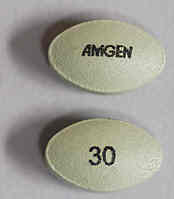
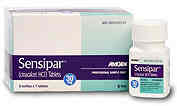 Sensipar is a drug manufactured by Amgen. Sensipar is the trade name, the generic name for this drug is "Cinacalcet". Sensipar comes as a small pill in three strengths (30mg, 60mg, and 90mg). This drug was designed for the treatment of SECONDARY hyperparathyroidism. Secondary hyperparathyroidism is a disease that occurs in patients with kidney failure that are on dialysis. These patients do NOT get parathyroid tumors like patients with PRIMARY hyperparathyroidism. Patients with SECONDARY hyperparathyroidism are usually treated with a combination of medications along with dialysis to control all of the problems they have with the chemical balance of their blood (due to the lack of kidney function).
 Patients with PRIMARY hyperparathyroidism do NOT have kidney failure, and are NOT on dialysis. This entire website (parathyroid.com) is dedicated to the treatment of PRIMARY hyperparathyroidism. People with PRIMARY hyperparathyroidism have high calcium levels, high PTH levels and other issues (like kidney stones and osteoporosis) which are discussed on this website extensively. We cannot confuse primary and secondary hyperparathyroidism. Let us make this simple...if you have a parathyroid problem, and you are not on kidney dialysis, then you have PRIMARY hyperparathyroidism.
Sensipar was approved by the FDA for the treatment of SECONDARY hyperparathyroidism in March 2004. This drug works well in many patients who are on dialysis, and many thousands of patients with kidney failure are on this drug. (Editorial note: truth be told, it is not a great drug for patients with secondary hyperparathyroidism--not near the "wonder drug" it was thought). IMPORTANT..Sensipar is NOT approved (nor does Amgen support its use) for patients who are not on kidney dialysis. Sensipar is NOT FDA approved for the treatment of PRIMARY hyperparathyroidism. This is why your insurance won't pay for it. They shouldn't! Amgen--the maker of this drug, does not say this drug can be used for primary hyperparathyroidism... and they know why --- It can make things worse!
Several studies of Sensipar were conducted in patients with PRIMARY hyperparathyroidism in the past few years (mid 2000's). Patients with primary hyperparathyroidism were given Sensipar and the doctors measured their calcium levels and PTH levels. The biggest study had a total of 40 (forty) patients getting Sensipar, while 38 got placebo (not a very big study, was it?). The trial was to last 1 year. Only 28 of the 40 patients taking Sensipar (70%) were able to stay on the drug for one year--the rest got sick and were not able to take it. Of the 28 patients that took the drug for one year, 73% had a decrease in their blood calcium levels. Only 7% of patients had a decrease in their PTH values. All the patients still had the parathyroid tumor still in their neck, and even in patients who had lower calcium levels, when the drug was stopped, their calcium and PTH levels went back up--some even higher than before. The researchers did uncover a potential problem, however, that the bones of these people may not be any better, and they may be worse. This paper can be read here: Peacock M, Bilezikian JP, et al. Cinicalcet maintains long-term normocalcemia in patients with primary hyperparathyroidism. J Clin Endocrinol Metab. 2005;90:135-141.
This was a well conducted study (and paid for by Amgen of course), and like other smaller studies (yep, even fewer patients also paid for by Amgen), it shows that Sensipar will decrease the blood calcium in about 3/4 of patients. However, since the PTH doesn't go down in most people, it seems that the patient's bones are still exposed to excess PTH. The evidence is that even though the calcium goes down, it often CAUSES kidney failure and often makes osteoporosis WORSE. What is most important, is that at least 40% of people can't even take this drug because it makes them feel very sick (nauseated). See our publication below: Sensipar makes people worse, not better!
Our Experience With Sensipar and Primary Hyperparathyroidism.
We consult on nearly 3500 patients with PRIMARY hyperparathyroidism annually (we do not see patients with secondary hyperparathyroidism who are on dialysis). We have tried Sensipar quite a few times in the past for patients who were operated on somewhere else who we could not operate on, in order to see if the drug would make them feel better. We have also seen hundreds of people referred to us over the years who have been put on this drug because their doctor said that "surgery was too dangerous", or because the local surgeon tried to operate and couldn't find the tumor.
Now, in 2013 our opinion is clear: Sensipar is a drug that hurts people, makes them feel bad, and has no role in patients with primary hyperparathyroidism. We call Sensipar "the devil's drug", as it does nothing, makes people sick, decreases kidney function, and causes osteoporosis to become worse. All this for $650 per month!
We have NEVER seen this drug help a person with primary hyperparathyroidism. We have never seen this drug make somebody with primary hyperparathyroidism feel better. We have never seen this drug make somebody's osteoporosis better. We have seen hundreds of people made sick, just so their doctor could show that the blood calcium level decreased. Look folks, we are supposed to treat people, not numbers.
We have parathyroid patients sent to us by about 600 different endocrinologists every year. We can tell you this, the best endocrinologists know Sensipar is a drug of the devil and would never give it to a patient with primary hyperparathyroidism. We rarely see the really good endocrinologists giving this terrible drug to patients.
In 2012 the FDA approved Sensipar for use in primary hyperparathyroidism for patients who were "too sick to undergo surgery". Folks, we've done more than 20,000 parathyroid operations and have NEVER seen a patient that is too sick to have surgery. If they can eat breakfast, they are healthy enough to have a mini-parathyroid operation. Heck, once the tumor is out they are healthier almost immediately since their heart will beat better and stronger within hours of tumor removal. There is no such thing as a patient who is too sick for parathyroid surgery. Even if there were, giving a drug to make them feel bad is clearly NOT in their best interest. Nothing good will happen by taking Sensipar except that the calcium level will drop. The PTH level will remain high and the patients will become sicker, not better.
This is a big pharma company (Amgen) who wants to make money selling a drug that kills people and does not make them feel better. Our advice: spend 20 minutes with an expert parathyroid surgeon and get the damn tumor removed. There is no other disease that is so easy to cure!
Our experiences with this drug are very poor, and we have written the FDA and Amgen to make them aware of our findings... the abstract of our findings were presented at the biggest endocrine meeting in 2010: and then published in 2012:
Cinacalcet (Sensipar) provides no measurable clinical benefits for patients with primary hyperparathyroidism and may accelerate bone loss with prolonged use. Norman J, Lopez J, Politz D. Annals of Surgical Oncology May;19(5):1466-71
Presented at Endocrine Society 08. San Francisco, CA. June, 2010.
Cinacalcet (Sensipar) provides no measurable clinical benefits for patients with primary hyperparathyroidism and significantly accelerates bone loss with prolonged use.
James Norman, MD, FACS, FACE, and Doug Politz, MD, FACS.
Norman Parathyroid Center.
Introduction: Cinacalcet (Sensipar) has been shown to decrease calcium levels in patients with primary hyperparathyroidism (PHPT) in several small trials, however no other endpoints have been studied and long-term effects are not known.
Methods: 90 patients began Cinacalcet as an alternative to surgery for PHPT. Patients filled out a symptom questionnaire specific for PHPT. All had bone density DEXA scans before treatment and annually. All patients were followed as long as the drug was tolerated or until complications arose, at which time all underwent minimally invasive parathyroidectomy. Starting dose was 30mg/d and increased to 60 to 90mg/d as necessary. Serum calcium and PTH levels were studied at 3-4 month intervals. Symptom resolution was tracked.
Results: Women comprised 73% while 27% were men. The average age was 62 (range 19-90). Prior to treatment, serum calcium levels averaged 11.7 (range 11.0 - 15.1) and PTH averaged 126 (range 88-815). 93% had 2 or more classic parathyroid symptoms (average 5.3 symptoms, range 0-9). Cinacalcet had to be discontinued in 19 patients (21%) within 3 months because of nausea and vomiting. The remainder (n=71) were treated from 8 to 34 months. Calcium and/or PTH levels dropped in 98% of patients taking Cinacalcet, but this was intermittent in all patients, none had consistently normal calcium levels. Despite decreases in calcium, only 5 (7%) had any relief from their symptoms (p=0.08), and 11 (15.5%) said they actually felt worse (p<0.05). 23 patients had Cinacalcet for >1.5 years, all of which showed decreases in bone density. 19 of the 23 (83%) had significant reductions in bone density of 1.5 to 2.9 standard deviations below their starting point (p<0.01). Those on the drug longer had the most loss of bone density (R=0.83) losing density faster than 500 cohort PHPT patients with no therapy (p<0.05). All patients underwent mini, outpatient surgery and were cured. 96% had partial or complete resolution of symptoms within 2 months of surgery (p< 0.001).
Conclusion: Although Cinacalcet will cause intermittent reductions in serum calcium in patients with PHPT, this provides symptom relief in almost none. Prolonged use of Cinacalcet is associated with significant bone loss that is accelerated over bone loss seen in untreated PHPT patients. There appears to be no role for Cinacalcet in the treatment of PHPT; patients are better off with no treatment. Surgery remains the best choice for these patients.
Sensipar and Primary Hyperparathyroidism... What is the Bottom Line?
The bottom line is this: primary hyperparathyroidism is caused by a tumor of one (or two) parathyroid glands. Taking a pill every day will not remove the tumor. Taking a pill every day may actually accelerate the formation of osteoporosis--thus this drug does not appear to be a way to "avoid" parathyroid surgery. If your doctor thinks you can "avoid" parathyroid surgery, or "delay" parathyroid surgery by taking a pill every day... then print this and take it to him/her. There is no medical evidence ANYWHERE that suggests taking Sensipar will help you avoid surgery. In fact, all of the evidence is that 1/3 of you can't tolerate the drug because it will make you sick, and most of you will get a dramatic worsening of your bones. And THEN, you will get surgery to get the tumor out.
This drug will cost you between $620 and $1250 per month in the US. Most insurances will not pay it... and they should not. It is in your best interest to find an excellent parathyroid surgeon and get the parathyroid tumor removed. It can be done in less than 20 minutes by some experts... then get on with your life.