



Parathyroid surgery can be very tricky. Surgeons who don't do more than 50 parathyroid operations per year have a failure rate of about 15%. There are only a few surgeons in the world who do more than 50 parathyroid operations per year, and their failure rate is about 8-10%. We perform over 3500 parathyroid operations per year and our failure rate is about 0.5%. About 18% of the parathyroid operations we perform every year are for people who had a failed parathyroid operation somewhere else. We do 2 or 3 of these re-operations every day. Let's look at why people have a failed parathyroid surgery: There are only 3 reasons to need a second parathyroid operation:
Three reasons that a patient needs a second parathyroid operation:
- The surgeon could not find the diseased parathyroid gland at the first operation (about 88%).
- The surgeon removed one parathyroid tumor and the patient was one of 25% or so that have more than one tumor (this group is about 12% of our last 1300 re-operations that we performed)
- Many years after a successful operation, a patient gets hyperparathyroidism in another parathyroid gland (a different gland goes bad). This is far less than 1% chance of this happening every 30 years. This is incredibly rare and essentially never happens.
-
The inability of the surgeon to find the offending parathyroid gland accounts for about 88 % of all cases of patients needing a second parathyroid operation. This is called "persistent" primary hyperparathyroidism because it persists... it was never cured. In uncommon circumstances, the surgeon removed one tumor when the patient had two... This is very uncommon. Almost every single time the surgeon couldn't find the tumor and the patient needs a second surgeon to find the tumor. We operate on these folks several times per day because they had a surgeon who performs fewer than 50 parathyroid operations per year do their surgery.
-
The removal of one parathyroid tumor in a patient that has two parathyroid tumors is the second most common cause of failed parathyroid surgery. About 25-30% of patients with hyperparathyroidism will have more than one parathyroid tumor. If the surgeon simply removes one of the parathyroid tumors (adenomas) and the second one is not found (or commonly, not even looked for, and obviously not removed), then this patient will be "better", but not cured. This patient also has "persistent" hyperparathyroidism and needs a second operation. They still have a tumor that will slowly destroy their body. This is becoming very common because surgeons are getting lazy, and will only take out the one parathyroid gland that shows up on a scan. You must demand that your surgeon examine all four parathyroid glands or you have a good chance of needing a second operation.
-
Developing a SECOND parathyroid adenoma years after a successful parathyroid operation almost never happens, and accounts for far less than 1 % of all cases of re-operative parathyroid surgery. This is called "recurrent" primary hyperparathyroidism because the patient was cured for a long time and they developed another tumor many years later. If your surgeon does the operation correctly the first time, you should be cured for life in almost every case.
No matter where you read about parathyroid surgery you will see the same thing written: "make sure you have the most experienced surgeon you can find". Now you know why. There is no other operation with such discrepancy between experienced surgeons and inexperienced surgeons.
Examination of the Number one Cause of Needing a Second Parathyroid Operation -- Inexperience of the Surgeon Who Cannot Find the Parathyroid Tumor.
My name is Steve and I am writing on behalf of my wife, Tammy. Tammy chose to have a local surgeon (at a very large medical university) perform the parathyroidectomy. The operation ran for over 6 hours and he was unable to locate the correct tissues, after 15 biopsies. Tammy now has an 8 inch scar and still has this disease. To make matters worse, her voice-box nerve was injured and she can only talk in a whisper. I can't believe how bad things can turn out after an "elective" operation on such a healthy young woman. We want to come see Dr Norman ASAP and allow him to fix our problem. We sure wish we knew then what we know now!
OPERATED ON AT THE NORMAN PARATHYROID CLINIC: Adenoma removed and entire operation completed in 15 minutes, sent home in 1 hour. Disease cured.
I'm writing because we are desperate! My wife Kathy is 52 years old and has had two previous surgeries to remove parathyroids. Both were performed by general surgeons who do 'some' parathyroid operations but also do regular general surgery (breast surgery, hernias and the like). The second procedure was done at the Mayo Clinic, but it too was unsuccessful. I believe she might have two left according to the Mayo Clinic, but nobody knows for sure. They can find the normal parathyroid glands, but they cant find the parathyroid adenoma tumor. These surgeons would not be characterized as experienced endocrine surgeons and we are quite angry. Two operations, not sure how many glands they removed, 4 days in the hospital and still at square one!
OPERATED ON AT THE NORMAN PARATHYROID CLINIC: Adenoma removed and entire operation completed in 24 minutes. Sent home in 1.5 hours. Disease cured.
Dr. Norman:
Is there anything you can do for my wife? She had a parathyroid operation last month and they couldn't find the bad parathyroid gland. The biggest problem, however, is that they cut her voice-box nerve and that required a tracheostomy. Now we have the same parathyroid problem, but it is much worse--she has to breath through a tube in her neck and can't talk. Can you help us? Can you help?
OPERATED ON AT THE NORMAN PARATHYROID CLINIC: Adenoma removed and entire operation completed in 21 minutes. Sent home in 1 hour. Disease cured. Required Teflon injections of the vocal cord (separate procedure) so the tracheostomy tube could be removed.
Parathyroid surgery can be very simple when performed by experienced endocrine surgeons who specialize in this operation. When performed by surgeons who don't do this operation very often, the risk of bad problems is dramatically higher. See our page with published results and a commentary by the New York Times. There is plenty of data published in well over a dozen studies that shows that surgeons who perform less than 10 parathyroid operations per year have a cure rate of only 80%. That is, one out of 5 of their operations will be unsuccessful and will require the patient to have a second operation. The cure rate increases to about 90% for surgeons who perform parathyroid surgery about 25 times per year, increasing to about 95% for surgeons performing 50 or more parathyroid operations per year. We perform about 1800 per year, which is why our cure rate is 99.87%. The take home message, if your surgeon isn't doing AT LEAST one parathyroid operation (not thyroid!) every week, then you have an excellent chance that you need a second operation. You will read this on EVERY website, and every textbook on the topic of parathyroid surgery ever written.
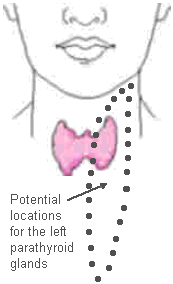 Here is the biggest issue with parathyroid surgery, and why the experience of the surgeon is very important to the success of parathyroid operations: When the 4 parathyroid glands are formed (before we are born), they migrate from one part of the neck to another. THUS, they are not always were they are supposed to be and they can potentially be high in the neck under the jaw or all the way down into the chest next to the heart! When you understand how the parathyroid glands are formed, you will understand why parathyroid anatomy is the most variable anatomy in the human body. The picture on the right shows that the parathyroid glands can be located from just below the jaw down to the area around the heart.
The typical story goes like this: A well meaning surgeon operates to remove a parathyroid tumor. The operation lasts considerably longer than expected and afterwards he has to tell you that he couldn't find the tumor. Remember, not finding the tumor is not malpractice. It happens. It happens to all surgeons. Heck, it even happens to us on occasion. It just happens more often to those who don't do this operation very often. The problem comes when an inexperienced surgeon is so set on not failing that he performs TOO MUCH dissection and too much operating in hopes of finding the tumor. This almost always ends up in him removing one or more NORMAL parathyroid glands (almost 100% of the cases that we see, which is BAD), and in almost 80% of cases, half of your thyroid (yep, thyroid not parathyroid). Remember, not curing a patient because the tumor couldn't be found is OK... it happens. But when normal thyroid tissue is removed and the good, normal parathyroid glands are removed... that is bad. This is the EXACT story we see several times every day. This is what you want to avoid.
"I think this tumor is in your chest". If your surgeon says that he/she did not find the tumor because its in your chest--print this page and roll it up so you can hit them with it. This is almost always a cop-out and excuse. About 99% of "missed" parathyroid tumors are in the neck, NOT in the chest. So if he/she says that the tumor is in your chest simply because they couldn't find it in your neck---then you should immediately become skeptical and you MUST move on to an expert in parathyroid surgery. It is at this point that you should realize that your surgeon is not telling the whole truth, and that he/she is not an expert at this disease. If they can't show you the picture of it in your chest on Sestamibi and they want to start getting all sorts of x-rays on your chest, then you need to find another doctor. Let us say this again... if you have an unsuccessful operation and the surgeon assumes that the tumor is in the chest and starts getting all sorts of x-rays of the chest (CT scans, MRI scans, Angiography, Venous Sampling)... then you need to move on to another doctor who is a national expert. This is NOT the sort of thing that is to be done at the local community hospital! You are soon to spend tens of thousands of dollars on unnecessary tests!!! We have NEVER seen a parathyroid tumor located in the chest that did not show on a good quality sestamibi scan. Of course, most sestamibi scans (even those done at big universities) are terrible quality. A high quality scan will always show tumors in the chest if they are in the chest. NEVER let anybody operate on your chest if they cannot 100% show you the tumor on a picture!
If a doctor orders parathyroid venous sampling or parathyroid angiography, then you need to move on to a new surgeon. This will not work. These tests are dangerous, cost well over $20,000, and we have NEVER seen one that helped locate the tumor. We have seen several cases where this test caused the patient to have their chest opened to find the tumor... that wasn't there. There is no reason to ever get one of these tests. It is wrong often, and helpful never. We have an entire blog page dedicated to parathyroid venous sampling.
When a surgeon operates and does not find the parathyroid tumor, the adenoma is said to be "missing". Almost all "missing" parathyroid adenomas are in the neck and will require the second surgeon to re-operate on your neck, almost always using the same incision that the first guy did. (hopefully you don't let the same guy do your second operation unless he/she is a true expert and endocrine surgeon). The tumor is almost always located in the neck very near where the first surgeon was operating, typically because they did not know where to look (they have not done this enough!!!). The second surgeon--who has done lots more of these operations--knows where to look and can go get the tumor. Second operations take longer and have a higher complication rate because of all the scar tissue inside--caused by the first surgeon's operation.
"I think you must have 5 parathyroid glands". When a surgeon operates and does not find the parathyroid tumor he/she will often give this excuse: "you must have 5 parathyroid glands, because I found 4 of them and couldn't find the tumor". If you are told this, then you should feel insulted. This is a crock of crap almost 100% of the time, and if you look at your pathology report you will see that he/she did NOT find 4 parathyroid glands. About in 350 people have 5 parathyroid glands. And, if a surgeon tells you that you were were not cured because you have 5 parathyroid glands and thus you have special anatomy, then you roll your eyes and ask for the pathology report to show where he/she biopsied the four glands. Find your pathology report, read it, see that he is fibbing to you. Then find yourself an expert parathyroid surgeon. If you can tell, we're tired of hearing this BS excuse from surgeons who don't find the tumor. OK, you didn't find the tumor, that's OK... but don't make it the patient's fault saying God gave them 5 glands and it that is why they are not cured. This is BS. Trust us folks, if you have had a failed parathyroid operation, its not because you have 5 parathyroid glands (unless the surgeon can show you a pathology report showing all four glands were found and biopsied--it happens to us about twice per year, and we do nearly 3000 of these operations).
At the Norman Parathyroid Center, we operate on a parathyroid patient who has been operated on somewhere else unsuccessfully between 2 and 4 times per day (about 8-12 per week). Some have been operated on 3 or 4 times previously--none of which were successful! These patients come from all over the US. Nearly all of them are cured of their hyperparathyroidism in less than 30 minutes (one of them took us 5 minutes, 32 seconds total time). Our average operating time for re-operations for our last 1000 is 35.5 minutes. The typical unsuccessful operation that these patients had previously took over 5 hours with almost every one of them staying in the hospital 2-4 days afterwards. There are only a handful of surgeons in the US who can re-operate on these patients with high success. Find one, (or better yet, find one for the FIRST operation).
There are several keys to re-operations for hyperparathyroidism (parathyroid disease). The most important is surgeon experience. The second is a great nuclear medicine team... your sestamibi scan should be so clear that you can read it. If it is not, it's not a good scan. The third key is Intra-Operative Nuclear Mapping... using a probe to find the radioactive parathyroid tumor. The technique that almost all experts agree should be used for re-do operations is the MIRP (minimally invasive radioguided parathyroidectomy). The re-do operation is VERY similar to the MIRP procedure which has a cure rate of almost 100 percent! Read more about the MIRP procedure here.
Prior to any re-operation, the experienced parathyroid surgeon will put lots of thought into your case. He will review all of your pathology reports and the operative reports to see what the previous surgeon did, and where mistakes may have been made. Often an inexperienced surgeon will remove your THYROID when they can't find the parathyroid. It is our opinion that this is terrible and should almost never be done. These details must be sorted out by your new surgeon, so expect your new expert (not the local guy!!) to spend considerable time figuring out what operation to do... and not to just jump in with a sharp knife. In our recent review of 500 re-operations that we performed between 1/03 and 12/07, we found that the previous surgeon removed one half of the patient's THYROID gland in 78% of cases, just because they couldn't find the parathyroid and thought that removing the thyroid gland they could find it. This should not be done. Thus, almost 80% of these patients had their thyroid removed for no reason, and most will have to be on thyroid hormone for the rest of their lives because their surgeon couldn't find the tumor. We also see surgeons who don't know what to do start ordering lots of tests. They order CT scans, SPECT-CT, 4D-CT, MRI, ultrasound and even parathyroid venous sampling (a test that nobody should ever have-- Read more about parathyroid venous sampling. If your doctors start ordering lots of tests, or better yet, if they send you out for TWO scans at the same time, then ask them why, and think about going somewhere else. The answer isn't in more scans, the answer is in better quality scans. Be smart!
What to read next
Note: read our page on "What Patients Say"... there are stories there from dozens of people who had to have a re-do operation because their first surgeon could not find the tumor. Almost every time the story is the same... they went to a local surgeon who somebody said was the "best in our area"... but really is no more a parathyroid expert than my tabby cat is a lion. Please... pick your surgeon wisely... we would love to stop hearing these horror stories!