



If you have been told that you have low vitamin D then this page is for you. There are two reasons for having low vitamin D. One reason for low vitamin D is not serious and simply means you need to take some vitamin D pills. The second reason for a low vitamin D is much more serious (and less common) and may indicate that you have primary hyperparathyroidism and need an operation to remove a small parathyroid tumor. These folks should not be taking vitamin D until after the parathyroid operation. If you have low vitamin D, you must understand which of these two groups you are in.
We will give a short synopsis of Vitamin D in the blood, and what Vitamin D does for our bodies... with some facts and take away points. If your doctor put you on high doses of vitamin D, then you must know why your vitamin D is low. If your doctor said the words "secondary hyperparathyroidism" to you and put you on high doses of vitamin D because your calcium is not normal then you need to read this page and watch the video. Here we go...
Overview of Vitamin D
-
Vitamin D is essential to our bodies. We can't make it, so we have to get it in our diet, or get outside and have the sun make it for us (yep, sun light on our skin causes our skin to make Vitamin D).
-
Vitamin D has several roles in our bodies, but its main role is to help us keep our calcium levels up. It helps our intestine to absorb calcium from the foods we eat, thus increasing the amount of calcium in our bodies. If our Vitamin D levels are low, then our intestines have a hard time absorbing calcium. This is why milk is fortified with Vitamin D. Did you ever notice that the milk you buy has "Vitamin D Fortified" written on it. We want our kids to drink milk so they get lots of calcium to build their bones strong... but without the Vitamin D, most of the calcium in the milk won't get absorbed. Our intestines MUST have at least a little Vitamin D to absorb calcium. Most of the calcium supplements out there (Citracal, Oscal, Caltrate, etc) will have Vitamin D added to the calcium pills, because our intestines need the Vitamin D molecule to absorb calcium through the intestinal wall and transport it into our blood. Again.... Vitamin D's most important role is to help our intestine absorb calcium.
-
Thus, increasing a person's Vitamin D levels will increase the amount of calcium they absorb from their diet. If a person takes more Vitamin D, then the intestines will become more efficient at absorbing the calcium molecules in their diet, and these calcium molecules will be absorbed... and the blood calcium will go UP.
-
Technical but important info: It is important to understand that there are TWO forms of vitamin D in the blood: Vitamin D-25, and Vitamin D-1-25. Doctors measure the Vitamin D-25 because it lasts longer in the blood and is easier to measure, however, vitamin D-25 is not active--it doesn't do anything. Vitamin D-1-25 is the ACTIVE form of Vitamin D. The 1-25 form of this molecule is the one that makes us absorb calcium. Doctors don't measure Vitamin D-1-25 because it doesn't last long in the blood. Here is the important part: The inactive Vitamin D 25 is converted to the active vitamin D 1-25 in the kidney and this activation is much higher in patients with primary hyperparathyroidism. Thus almost everybody with a parathyroid tumor has low vitamin D in their blood!
-
Almost every patient with primary hyperparathyroidism (due to a parathyroid tumor and treated with surgery to remove the tumor) will have low vitamin D-25. This is extremely important to you! If your calcium is even a little bit high and your vitamin D-25 is low, then you are almost guaranteed to have a parathyroid tumor and PRIMARY hyperparathyroidism. Keep reading--you do not want to take vitamin D! You do NOT have "secondary" hyperparathyroidism.
Let's Graph the Two Causes of Low Vitamin D
The following graph illustrates that there are two causes of Low Vitamin D: The first is that it is just low because you aren't getting enough of it in your diet and/or you are not going outside enough (vitamin D is made in our skin when exposed to the sun) (the yellow blob). The second reason for a low vitamin D is that you have primary hyperparathyroidism due to a small tumor in your neck and the body converts all the vitamin D-25 (that your doctor is measuring) to the active Vitamin D-1-25 (that doctors do not measure). This is the blue blob on the graph. Look at the graph carefully where we show Vitamin D Levels on the vertical (Y) axis, and Blood Calcium Levels on the horizontal (X) axis. The green box represents most people who have normal vitamin D levels (between 30 and 65) and normal calcium levels (in adults over 35) (between 9.0 and 10.0). The blue blob represents the vitamin D levels in 25,000 of our patients who we operated on for primary hyperparathyroidism. You can see that most people with a parathyroid tumor (primary hyperparathyroidism) have low vitamin D. In fact, the smaller purple circle shows where 95% of all patients with primary hyperparathyroidism are on this graph... they have calcium levels between 10.2 and 11.4, and Vitamin D levels between 8.5 and 33. Thus, almost everybody with primary hyperparathyroidism (due to a parathyroid tumor in your neck) will have low vitamin D-25. You can tell the difference because the calcium level is 10.2 or higher.
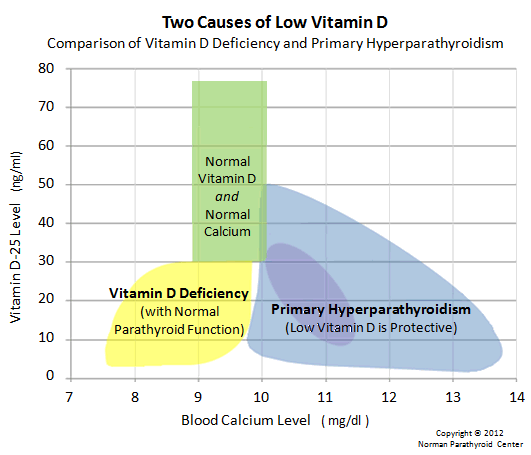
Let's keep looking at this graph... If you really have low vitamin D (and not a parathyroid tumor), for which your doctor may want to give you vitamin D pills, then you should have a normal or LOW blood calcium. This is represented by the yellow blob--people who have low vitamin D can develop a low blood calcium level, but usually we have so much reserves (our bones) that almost all people with a low vitamin D-25 level due to the fact that they don't get enough Vitamin D in their diet or they don't go out in the sun enough will have normal blood calcium.
This very important graph is included in the CalciumPro Parathyroid Diagnosis and Risk-Assessment app. Download this app ($2.99) so you can graph your personal vitamin D and calcium levels. The app is very accurate and will tell you if you have a parathyroid problem or a vitamin D problem.
Here is the most important fact on this page: since vitamin D is required for humans to absorb calcium in their intestines, a low vitamin D cannot ever be the cause of high blood calcium. This fact is not debatable. Thus, if you have a low vitamin D and your calcium is above 10.0, then the high calcium in your blood must have come from somewhere else other than your diet (it came from your bones). Thus, if you have a low vitamin D, and a calcium level above 10.1, then you are almost guaranteed to have primary hyperparathyroidism and need surgery to remove the parathyroid tumor. A low vitamin D cannot ever be the cause of high blood calcium. Keep reading, because most doctors get confused between the yellow and the blue blobs.
My Doctor Said I May Have Secondary Hyperparathyroidism.
My Doctor Gave me LOTS of Vitamin D for my Low Vitamin D Level.
The most common mistake we see from family doctors and endocrinologists regarding the diagnosis of primary hyperparathyroidism is that the low vitamin D confuses them and they think the patient has SECONDARY hyperparathyroidism. In other words, they think the low vitamin D was the CAUSE of the high blood calcium because the low vitamin D caused the parathyroid glands to become over-active. They then think that they can fix the high calcium by giving you high doses of vitamin D. We're here to tell you that there is no such thing as secondary hyperparathyroidism caused by low vitamin D that results in calcium levels above 10.1. No Such Thing. These doctors don't understand the graph above, and don't understand that almost all patients (94%) with primary hyperparathyroidism have a low vitamin D (average was 21.4 ng/ml in our last 28,000 patients--right in the middle of the blue blob). So, these doctors will say: "your vitamin D is low, and your calcium is a little high, I think you may have secondary hyperparathyroidism due to the low vitamin D, so here is a prescription for 10,000 (or 50,000) units of vitamin D. Take this high dose of vitamin D and come back in 3 months and we will check your calcium and vitamin D levels again". Trust me folks, those exact words will be said--we hear it dozens of times per day--and it is wrong every time. Since vitamin D is required to absorb calcium in our diet (this is the primary function of vitamin D), then a low vitamin D will cause you to absorb LESS calcium, not more.
If you are over 35 years of age, and your blood calcium is high (over 10.1) you are almost certain to have primary hyperparathyroidism--a disease caused by a tumor. If your blood calcium is high and your vitamin D level is low, then you are almost guaranteed to have a parathyroid tumor (primary hyperparathyroidism). As we discussed above, the vitamin D is low because they are measuring vitamin D-25 which the parathyroid tumor converted into Vitamin D-1-25 (the active form of vitamin D that your doctor is not measuring). Keep reading... you are learning a lot here, and will know more than your doctor in about 5 more minutes.
If your endocrinologist tells you that your calcium is high because your Vitamin D levels are low... and wants to give you Vitamin D to make your calcium go down... then you should print this page and take it to them. This is wrong. You should also download the CalciumPro app on your iPad, iPhone, or Android phone/tablet. The CalciumPro app will graph your data so you can show it to your doctor. If you have read this far down on this page, then you need this app--it will save you from getting lots of silly tests and wasting your time and money. Just go to the app store and search for "Calcium" or "Parathyroid"--the CalciumPro app is number 1.
Vitamin D and It's Relationship to Hyperparathyroidism (Parathyroid Disease)
-
Hyperparathyroidism is associated with high calcium in the blood. The cause is a parathyroid tumor. This is discussed throughout this website, so we will not go into it here. Basically, a tumor grows from one of your parathyroid glands... this tumor produces parathyroid hormone which takes calcium out of your bones and puts it into your blood. You get osteoporosis and feel bad because of the high calcium in the blood.
-
The body doesn't want the calcium to be high... So, it will try to get rid of the calcium in the urine... which is why many patients (about 1/3) will have high calcium in the urine (they can get kidney stones from this).
-
The body also wants to shut down calcium absorption from your intestines. It does this by limiting the amount of Vitamin D in your body. Thus, if your body determines that your calcium is too high... it can decrease the amount of calcium that is absorbed from your intestines by decreasing the amount of Vitamin D available. If your Vitamin D levels are decreased, you can't absorb so much calcium from your diet. This is a protective measure. It happens by taking the long-lasting Vitamin D-25 and converting it to Vitamin D-1-25 which only lasts a couple of days in the blood.
Vitamin D in Patients with PRIMARY Hyperparathyroidism
We began measuring Vitamin D levels in patients with hyperparathyroidism in the mid-1990's. For the past several years, we have measured it in most patients, and beginning in 2003 we began measuring Vitamin D in every patient with PRIMARY hyperparathyroidism. Here is what we found in our recently published article on 10,000 patients with primary hyperparathyroidism:
84% of all patients with primary hyperparathyroidism will have LOW Vitamin D-25 Levels! This is 8,397 patients out of 10,000 in our study. 3812 patients (38%) had levels below 20 ng/ml with an average Vitamin D level of 14.6. A more recent study by our group in 25,000 patients showed 92% of patients with a parathyroid tumor and primary hyperparathyroidism have low Vitamin D-25.
The average Vitamin D level in patients with a parathyroid tumor removed at surgery was 21.4
Less than 10% of all patients with primary hyperparathyroidism will have NORMAL Vitamin D-25 Levels (above 30). Their average Vitamin D level was 35.3 ng/ml. (Note that some patients will have normal vitamin D levels because they have been taking vitamin D when the test was done).
0 % of all patients with primary hyperparathyroidism will have HIGH Vitamin D-25 Levels We've never seen it in over 30,000 patients with parathyroid tumors.
As the calcium level increases, the level of Vitamin D-25 decreases. The following graph shows this nicely. When we look at 18,000 patients with a parathyroid tumor (we know it because we removed the tumor and gave the patient a picture of it), we see that those with higher calcium levels tend to have lower Vitamin D-25 levels. As you will read below, this is because the body is trying to protect itself from the high calcium, and it is converting one form of Vitamin D (Vit-D-25) into another form (Vit-D-1-25). The body is protecting itself from the high calcium by trying to get rid of the vitamin D. It does this by decreasing the amount of overall Vitamin D in our body so we don't absorb as much calcium in our diet. As you can see from the graph below, the higher a patient's calcium goes, the lower the Vitamin D-25 goes.
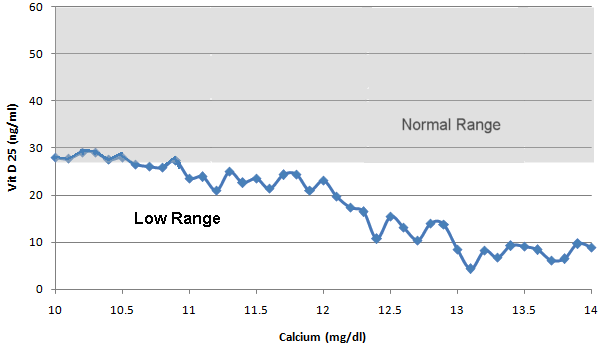
Figure 1: Vitamin D-25 levels in 10,000 patients with primary hyperparathyroidism due to a parathyroid tumor. This graph shows the average Vit-D-25 level for all patients. The line is an average, so there are about half of the patients who have levels above the line, and about half of them have levels below the line. As you can see, the line goes down as the calcium levels increase. Said more scientifically, Vitamin-D25 levels decreased linearly as calcium levels increased such that 79% of those with calcium levels above 12 mg/dl had Vitamin-D25 less than 20 (p<0.0001, R=0.91).
Most patients with a parathyroid tumor will have low Vitamin D-25 levels. Those patients with more severe primary hyperparathyroidism (those with larger tumors and those who have had the tumor a longer time) will have higher blood calcium levels, which are associated with lower Vitamin D-25 levels. The lower your Vitamin D-25, the longer you have had hyperparathyroidism and a parathyroid tumor in your neck.
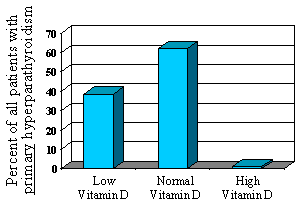 We have graphed this information using a different graph so you can see it clearly. This shows that nearly 40% of all patients with PRIMARY hyperparathyroidism have Vitamin D-25 levels that are below 20 ng/ml. 60% have vitamin D levels above 20, but that includes 29% who have levels between 20 and 30, which is considered "deficient". Nobody with a parathyroid tumor has high Vitamin D-25 levels. Thus, their body is trying to protect them from the high calcium, decreasing the amount of Vitamin D levels so they don't absorb so much calcium.
Well....... what is happening in these patients? What is the difference? Each of these patients had a high calcium levels in their blood and high (or inappropriately normal) PTH levels. Thus, each of them had primary hyperparathyroidism. Well, every one of these patients was operated on by us, and we found (as expected) that they all have the exact same parathyroid tumor! (sorry, we are getting complex now... if we lose you, then go to the basic pages and come back here later). That is, 98% of those with LOW vitamin D levels have a parathyroid adenoma and 2% have hyperplasia. 98% of those with NORMAL Vit D-25 levels have a parathyroid adenoma and 2% have hyperplasia. Thus, there is no difference in these people's necks... they all have the same parathyroid tumors causing their hyperparathyroidism... The Vitamin D levels have NOTHING to do with their disease. It is the parathyroid tumor that is causing the body to decrease the amount of Vitamin D-25. Not visa versa.
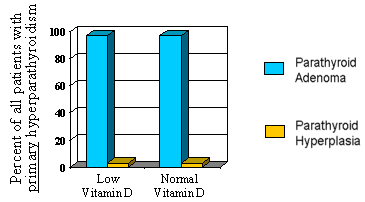 This graph shows that 98% of people with primary hyperparathyroidism have a parathyroid adenoma (tumor) and 2% have hyperplasia... REGARDLESS of what their Vitamin D level is. Thus, if your calcium is high, you have a parathyroid tumor and it doesn't matter what your Vitamin D level is. The vitamin D is not causing the parathyroid problem... The low vitamin D is GOOD... it is protecting you from even higher calcium levels.
 THEREFORE: If you have high blood calcium and low vitamin D, you must have a parathyroid tumor in the neck and you need an operation to remove the tumor. It is a tumor and it will not go away. Low Vitamin D levels do not cause the problem, they are a result of the problem. The low vitamin-D levels is the body's way of preventing the intestines from absorbing more calcium. The body is protecting itself! Do not avoid parathyroid surgery because your doctor says your vitamin D level is low, and that the low vitamin D is the cause of your problems. This is silly and there is no way our body's can do this. If your doctor says that, then he/she doesn't understand the difference between the yellow blob and the blue blob in the graph above.
This is a myth, and this myth is busted. The low Vitamin D did NOT cause the high PTH and high calcium... in truth, the parathyroid tumor is making PTH which is taking calcium out of the bones and putting it into the blood--that is where the high calcium came from.Furthermore, it is very typical for patients with parathyroid tumors to have calcium levels that go up and down... high sometimes and back to normal some times..... this is typical for patients with parathyroid tumors. The tumor doesn't regulate the calcium well, and the levels go up and down.
Why are we discussing Vitamin D and hyperparathyroidism? Because this has become a huge problem since 2007. Now that Vitamin D-25 is easy to measure, many doctors (endocrinologists) will measure Vitamin D levels on all patients with high calcium in the blood. They will also measure the PTH levels... they are trying to prove (correctly) that the high calcium in the body is due to a parathyroid tumor. Here is where they go wrong... and this is getting very complex.... If the Vitamin D level is low, then they think this is the MAIN PROBLEM. They think that the low vitamin D levels cause too little calcium to be absorbed in the intestines. They think that this low amount of calcium is sensed by normal parathyroid glands which causes the normal parathyroid glands to appropriately increase their production... causing a high PTH level. They further believe that this high PTH level will take calcium out of the bones and increase the calcium in the blood. Thus, they think the PTH levels are high because of the low vitamin D levels... thus they think the high PTH levels are high SECONDARY to the low vitamin D levels... thus they will tell you that you have SECONDARY hyperparathyroidism. THIS IS A MYTH. THIS IS NOT CORRECT. Measuring vitamin D levels has nothing to do with making the diagnosis of hyperparathyroidism. Low Vit D levels will NEVER cause high calcium levels. It is not possible.
This video shows a lecture of Dr Norman at the 2010 Annual Meeting of the American College of Endocrinology (discussing the "secondary hyperparathyroidism" myth).
Watch a video at https://www.youtube.com/embed/LoaSJAz6JqA
To defend the endocrinologists (who mean well, but don't see enough patients with hyperparathyroidism to be "expert" at it... we see 3,500++ patients per year with this problem), it is possible to have LOW vitamin D levels to cause your PTH to go up a very little bit. But this will NEVER increase the calcium in the blood, and the PTH will only go up slightly (like up to 75). Sometimes your endocrinologist will try to give you Vitamin D as a trial... to see if your parathyroid problem is due to low Vitamin D. The theory is that giving you Vitamin D will cure the cause of the high PTH... and all your labs will go back to normal... They call this "secondary" hyperparathyroidism and they will give you a prescription for high doses of Vitamin D. HOWEVER, this can be dangerous... if your calcium is above 11.5, the additional Vitamin D can make your calcium go above 12 and we have even seen 4 patients have a stroke because of this, and another 39 patients need to be admitted to the hospital because their calcium was so high (updated 2/13/12).
Getting complex even further... If you are still with us... If the low vitamin D was the starting point... if the low Vitamin D was the main problem... and this caused the parathyroid glands to increase their parathyroid hormone production... then we would be idiots to operate on these people... and if we did, we would find them to all have normal parathyroid glands... they wouldn't have 3 normal parathyroid glands and one parathyroid tumor. If the low Vitamin D caused the parathyroid glands to get big, they would all four get big... but that is NOT what happens! Patients with low Vitamin D levels have parathyroid tumors just like people with normal vitamin D levels. Remember, parathyroid adenomas are tumors. The entire tumor mass is made of cells from one parent cell that went crazy and reproduced itself millions of times. Parathyroid adenomas are TUMORS... (did you see our page showing 80 typical photos of these tumors?). Low Vitamin D does not cause TUMORS to grow. It is the other way around.
We have even seen an endocrinologist get sued for malpractice because he gave a patient with primary hyperparathyroidism high doses of Vitamin D which caused the patients calcium to go high and cause the patient to have a stroke. This is not a smart move. If your calcium is high, you should not take Vitamin D in large doses. If you do, you will find that it almost always makes your symptoms of hyperparathyroidism worse. Is it going to cause you to have a stroke? Nope, that is extremely rare, but it will make you feel bad and it will waste your time and money. If your calcium is high, you have a parathyroid tumor (PRIMARY hyperparathyroidism) regardless of what your Vitamin D level is.
Remember above when we were discussing Low vitamin D... saying that decreasing the Vitamin D in your body is the body's way to protect itself from the high calcium? If this is true, then we should see the low Vitamin D levels in patients with hyperparathyroidism return to NORMAL once the parathyroid tumor is removed. Well, in January 2007 we began a trial to test this theory scientifically (we had observed it many times, but we decided to test it scientifically so we can publish it in a major medical journal... we publish on parathyroid topics about every other month). Guess what!? 85% of all patients with LOW vitamin D levels had NORMAL vitamin D levels 3 months after their parathyroid tumor was removed!! Thus, proving yet another way, the body doesn't like having high calcium which is due to the parathyroid tumor. The body turns off Vit D so we don't absorb as much calcium. When the parathyroid tumor is removed, the body turns the Vitamin D back on and the low vitamin D levels increase back to normal.
The bottom line again: If your calcium is high, you almost certainly have a parathyroid tumor. If your calcium is high and your Vitamin D is low, you STILL have a parathyroid tumor. If your calcium is high and your Vitamin D is normal, you STILL have a parathyroid tumor. When you get your parathyroid tumor removed, your Vitamin D level will almost always correct itself within a few months.
If your endocrinologist says "you have secondary hyperparathyroidism because your Vitamin D level is low", then you MUST print this page and take it to them! This is not correct. You have PRIMARY hyperparathyroidism... and 87% of people with primary hyperparathyroidism have a low Vitamin D level (below 30 ng/ml). This is expected. Get the tumor removed and get on with your life. Secondary hyperparathyroidism due to low vitamin D is never associated with a high calcium level in your blood. NEVER. If they put you on Vitamin D and then measure your calcium a month later... and your calcium gets better.... then they are fooling you and themselves... it will be bad again one month later, and you will feel bad. Trust me! This will make you feel bad. Get the tumor removed!
In June 2009 Dr Norman gave a lecture to the Endocrine Society's Annual Meeting in San Francisco, CA on Vitamin D in parathyroid disease. Here is an abstract of this talk; the journal article was published in 2009. Print this and take it to your doctor who put you on Vitamin-D. Most endocrinologists know this already, but many do not:
Vitamin D -25 is suppressed and Vitamin D-1-25 is increased in patients with primary hyperparathyroidism in linear fashion as calcium levels increase, returning to normal within weeks of tumor removal. A protective mechanism is in play.
Overview: Vitamin D-25 is converted to Vitamin D-1-25 in patients with primary HPT in a linear fashion as calcium levels increase. Thus the vast majority of patients with primary HPT will have low Vit D-25 that normalizes by itself in most patients within several months.
Objective: Vitamin D-25 is often measured in patients with apparent primary HPT to rule out a possible secondary cause. This study was undertaken to examine if a relationship exists between Vit-D levels and parathyroid pathology in patients with elevated calcium levels.
Methods: A prospective, single institution study measured preoperative Vitamin D (25OH and 1-25OH) in 1,587 patients undergoing surgery for sporadic primary hyperparathyroidism (PHPT) over a 1-year period. All patients underwent curative parathyroidectomy with pathology noted. Patients were put on nominal doses of Vit-D postop contained within supplemental calcium tablets (Citracal+D; 250 IU cholecalciferol daily) for two months; none took additional Vit-D. Blood levels were measured at 1 and 2 months post-op.
Results: All patients had primary HPT with high serum calcium and PTH preop that normalized at all postop measures indicating cure. The average preop Vit-D25 was 25.8+10 ng/ml (range 4-65). 1039 patients (67%) had Vit-D25 levels below 30 ng/ml preop, while 594 patients (38%) had levels below 20 ng/ml preop (mean 14.6, range 4-19), No patient had high Vit-D25 preop. Vit-D25 levels decreased linearly as calcium levels increased such that 71% of those with levels above 12 mg/dl had Vit-D25 <20 (p<0.01, R=0.91).The levels of Vit-D1-25 were low in 0%, normal in 58.5%, and high in 41.5% (mean 56.2 + 14)(p<0.01). The findings at surgery were identical (p=0.98) for those with low vs. normal Vit-D25 (single adenoma=92%, double adenoma=6%, 4-gland hyperplasia=3%). 82% of patients with low preop Vit-D25 had increased levels at 1 month postop (mean 41.4+12, range 17-63, p<0.005), increasing to 91% at 2 months. All patients with normal Vit-D25 preop remained normal postop. 68% showed decreased Vit-D1-25 into the normal range (p<0.001) within 1 month of surgery.
Conclusion: Vit-D25 levels decrease in a linear fashion as calcium levels rise in patients with primary HPT. Overall, 38% will have Vit-D25 levels less than 20 ng/ml, increasing to 71% of those with calcium levels above 12mg/dl. Vit-D1-25 shows the opposite pattern suggesting a protective mechanism. The pathology found at surgery is identical in PHPT patients with low versus normal Vit-D25 indicating no causal relationship. Low Vit-D25 should not be interpreted as signaling secondary HPT in patients with elevated calcium levels. The vast majority of patients will normalize their low Vit-D25 and high Vit-D1-25 levels within 2 months of tumor removal.
What to read next
- Watch the video of a 13 minute parathyroid operation. A great learning video (and no blood!)
- Download the CalciumPro app. It will walk you through this entire process and make you an expert while you have fun playing with the cool graphs.
- How to become our patient
This page was last updated: 08/01/2016