


 Minimally invasive parathyroid surgery was pioneered in the early 1990's by the work of Dr James Norman, MD
while being the Director of Endocrine Surgery at the University of South Florida in Tampa, FL. Dr Norman learned
how to perform parathyroid surgery like all other surgeons: make a big incision and dissect and explore until you
find the four parathyroid glands; decide which one is bad and take it out--and keep exploring to see if there are
any more bad glands. As he performed more and more parathyroid surgery, he could not believe that in the era of
mini-surgery for galbladders and knee scopes, people had to have their neck slit open to find a tumor the size of an
olive. "There had to be a better way! Digging around in somebody's neck hoping to run into a tumor was the dumbest
thing I had ever seen in my life!"
Minimally invasive parathyroid surgery was pioneered in the early 1990's by the work of Dr James Norman, MD
while being the Director of Endocrine Surgery at the University of South Florida in Tampa, FL. Dr Norman learned
how to perform parathyroid surgery like all other surgeons: make a big incision and dissect and explore until you
find the four parathyroid glands; decide which one is bad and take it out--and keep exploring to see if there are
any more bad glands. As he performed more and more parathyroid surgery, he could not believe that in the era of
mini-surgery for galbladders and knee scopes, people had to have their neck slit open to find a tumor the size of an
olive. "There had to be a better way! Digging around in somebody's neck hoping to run into a tumor was the dumbest
thing I had ever seen in my life!"
This 'Standard Old-Fashioned Parathyroid Surgery' has some very BIG problems!
The concept that "parathyroid glands can be anywhere in the neck or chest" is not correct. They can be many places in the neck (or chest) but they can't be "anywhere".
Exploring through the entire neck should never be done. It is dangerous because of all the nerves and blood vessels. No more "exploring"! Use technology and new tools, not brute force.
If a parathyroid tumor is typically only 1/2 inch in diameter, why make an 8-10 inch incision?
The old method had no way to determine if a parathyroid gland was good or bad--other than just looking at it. Trust us, this is incredibly dumb... it can't be done.
In order to have a cure rate over 80%, and in order to avoid a second operation within 10 years in 20-30%, all four parathyroid glands should be evaluated. Just removing the tumor that shows on the scan will fail to cure 20 to 30% of people.
The concepts of mini-parathyroid surgery are simple:
- Know with a very high degree of accuracy where the tumor is located before the operation so you don't have to dissect all of the neck structures trying to find it. This does NOT mean the patient needs a positive scan...or any scan for that matter. You do NOT need a positive scan to have a mini-operation! Be careful here folks... there are dozens of "wanna-be" parathyroid experts who put up a fancy website and claim to do mini-parathyroid surgery--the guys in New York and Atlanta come to mind. What they won't tell you is they won't operate if your scan is negative, and they will ONLY remove the tumor that shows on the scan. They won't look at all four parathyroid glands. This isn't a scam, but it is not the best surgical care. Be careful of a surgeon that says this:"we'll take out the tumor that shows on the scan and then measure your hormone levels to see if we got it all". That is an operation a surgery intern could do. That is not an operation performed by an expert. Your surgeon should examine all four parathyroid glands... If you watch our video you will understand this concept.
- Know with a very high degree of accuracy where the tumor is NOT located prior to the operation. This is a more difficult concept to understand, but this is what allows a select few surgeons perform mini-parathyroid surgery on ALL patients - not just patients who have a positive scan. This is the concept we live by... knowing where the tumor is NOT located is the most important thing that a scan can tell you. Thus, the negative scan is just as good as the positive scan! It just means that surgeons should understand where the tumor is NOT located so they don't have to explore everywhere. Read Dr Norman's invited editorial in the Journal of Surgical Oncology in 2012 discussing that negative scan patients should have mini surgery also, and that doctors should stop emphasizing the scans. Norman J. Controversies in parathyroid surgery: The quest for a "mini" unilateral parathyroid operation seems to have gone too far. J Surg Oncol. 2012 Jan;105(1):1-3
- Make a small incision and take out the bad parathyroid and examine the status of the other 3 parathyroid glands. Use technology to determine if and when the patient is cured. Use more modern science, and not big knives! You must make sure all the other glands are asleep (making no hormone), because about 25-30% of people will need more than one parathyroid gland removed.
- Do not remove the normal parathyroid glands. This sounds obvious, but normal parathyroid glands are removed at about 90% of parathyroid operations because of surgeon inexperience and the lack of the newest technology in the operating room that can tell the difference between a gland that is asleep (dormant) and one that is awake and making hormone. Two or three parathyroid glands will be normal in about 98.5% of people. Virtually 100% of patients that come to us for their second (or third) parathyroid operation after a failed operation somewhere else have had one or more normal parathyroid glands removed because the surgeon isn't experienced enough to distinguish normal glands from small tumors.
- Don't "EXPLORE" the entire neck like surgeons have done since 1925. Use modern tools and techniques to help find the bad gland, and don't go on a 'wild goose chase'. Avoid "exploring" all parts of the neck! This is very important... use tools and technology (and experience), and not brute force!
- If you can make a small incision, then you can do the operation as an outpatient with light anesthesia (over 99% of our last 60,000 parathyroid patients have gone home within 3 hours of their operation).
- Cure rates should be higher if we can do a more precise operation -- and they are. Cure rates for MIRP are expected to be around 95% if your surgeon does two (2) or more of these operations per week (we average about 72 per week and have a cure rate of 99.6%).
- We believe strongly that almost everybody needs all four glands examined, but this can be done using a MUCH smaller operation using radioguided (MIRP) techniques. The probe tells the doctor which glands are bad and which ones are good! All patients can have a mini parathyroid operation by a parathyroid specialist who does mini parathyroid surgery regularly. Watch our video--the best page of this website. If you understand the video page of this website, you will understand more about parathyroid disease than most endocrinologists...it is sad, but true.
- Don't wait until patients suffer from depression, fatigue, kidney stones and osteoporosis to tell them that there was a 15-20 minute operation that could have prevented these complications long ago! Fix the parathyroid problem and remove the parathyroid tumor before it ruins the patient's life!
- Don't wait until the woman gets breast cancer before you tell her that the high calcium in her blood could have been the cause of the breast cancer. Get the darn tumor removed!
- Bottom line... It is all about the surgeon and his/her operating team. You must get an experienced surgeon. If your surgeon says he/she has all the tools to do mini-parathyroid surgery, but they don't perform two (2) of these operations per week (or more)... then go somewhere else. Would you fly on a plane that the pilot only flies a couple of times per month... or less? Parathyroid surgery is more about the experience of the surgeon than the tools he/she uses. We know most people can't come to Tampa for an operation, but please, pick an experienced surgeon.
There is no blood and it is very informative! If you have a parathyroid problem, then you should see this movie... the entire operation takes less than 13 minutes to test all four parathyroid glands.
Mini-Parathyroid surgery is now available, and has become the preferred method of operating on parathyroid glands. Sorry, but this is not available everywhere, but it should be. Just like laparoscopic gallbladder surgery has replaced the old-fashioned 'big' gallbladder operation, Mini Parathyroid Surgery has replaced the old fashioned parathyroid operation. Just like laparoscopic gallbladder surgery, almost all patients can have the new mini-parathyroid operation, and in our opinion, nobody requires the old big "exploratory" surgery. Don't let your doctor tell you that you need a big "standard" operation because you have a negative scan... All patients with a negative scan can still have mini surgery--if your surgeon knows how to do it.
Think twice before you let your surgeon do an old-fashioned parathyroid operation on your neck. Also, be leery of a surgeon who says that they see the tumor on the scan and they will go remove it and measure your PTH hormone while you are on the operating table. This technique will have a failure of at least 12%, and even if you are one of the 88% that are cured, you have a 10-11% chance of needing another operation in the next 10 years. This is why we examine and determine the activity of all four parathyroid glands in almost all our patients. Please make sure your surgeon is a parathyroid expert and can do mini parathyroid surgery. If he/she is not performing parathyroid surgery at least once per week, then go somewhere else. If you have to spend the night in the hospital after your parathyroid operation, then go somewhere else. If they tell you that they may have to take out all of your parathyroid glands and put one in your arm... then RUN as fast as you can! If they say they are going to put you asleep with a tube that monitors your voice box nerve, then you may want to see somebody else. If your surgeon can't tell you that this is easy with an expected complication rate of less than 1% and a cure rate of over 95%, then go somewhere else.
There are numerous potential advantages to minimally invasive radioguided parathyroidectomy.
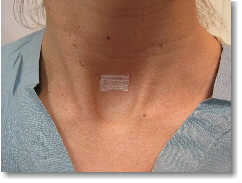
First of all, the surgeon has a very good idea which one of the four parathyroid glands is hyperactive prior to beginning the operation. Even if a patient has a negative scan, there is so much information on the scan (where the tumor is NOT located) that the experienced surgeon knows where to go find the tumor. This allows the surgeon to operate on one very small area of the neck (right around the thyroid gland) rather than exposing the entire neck. If the operation only takes place in a much smaller area of the neck then the potential risks of this procedure are expected to be less than half of that seen during a complete neck exploration (a number of reports of MIRPs in the medical literature have shown a lower complication rate about 80% less than the standard operation). If you are contemplating parathyroid surgery, ask your doctors about this procedure, you will be glad you did. You wouldn't have the old fashioned gallbladder surgery, so don't settle for a parathyroid operation designed in 1925! If your doctor is not aware of this operation, please feel free to have them contact Dr Norman directly. The picture here shows a band-aid size for a woman weighing about 135 pounds. This lady is 4 days after her operation. The band-aid comes off in one week. There are no stitches to take out.
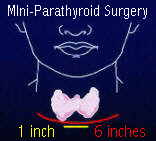 Another advantage of the MIRP parathyroid surgery technique is that it does not require an endotracheal tube and deep anesthesia. You almost never need a tube in your trachea with a machine breathing for you during the operation. Mini-parathyroid surgery is usually performed using light general anesthesia with an LMA. LMA anesthesia allows the patient to be out for the procedure, but awake enough that they breathe for themselves and wake up completely within a few minutes. The operation is typically performed through a 2.5 cm (1 inch) incision (shown in yellow) rather than the usual 4 to 6 inch incision (shown in red). The surgeon is able to complete the operation through this smaller incision because he/she does not have to search the entire neck... the "negative" information on EVERY good quality scan tells the surgeon where they do NOT have to operate. Note that the size of the incision is based upon surgeon experience, and NOT on the patient's disease--this cannot be overemphasized).
Nerve Monitoring: Some surgeons will tell you that they will put a tube down your throat so they can monitor your vocal cord nerves. This is something we would never do. This is a crutch for surgeons who don't operate around the vocal cord nerve very often. They are doing it for one reason... and that reason is not YOU. They are doing it so you can't sue them if they cut your vocal cord nerve. Go ahead, ask them this question and they will tell you that the tube does not protect your nerve or decrease the risk of nerve injury--the tube is put in to protect the SURGEON from malpractice lawsuits. We think the tube is silly and reflects poorly on the surgeon. However, some good surgeons use this tube--just don't fall for the hype--the tube is not to protect you, the tube is to protect the surgeon's wallet.
The average operative time to remove the diseased parathyroid gland using this technique is about 25 minutes as compared to an operation which can take up to four hours (or more!). The ability to do the procedure this quickly means that minimal anesthesia is needed, and unnecessary dissection within the neck is avoided. These numbers are current numbers where we look at all four parathyroid glands. Remember, the only way to get over 99% cure rate and to make sure you don't need a second operation is to assess all four parathyroid glands in all patients, but this is a very specialized technique that few surgeons can do.This is discussed in detail on the next page. Combined, these advantages allow almost all patients to be sent home within an hour or two of the operation rather than spending one or two days in the hospital. It also means that the complication rate is less than half, and in some institutions, near zero. Most surgeons who are performing this type of mini parathyroid surgery send virtually all patients home following this procedure. Dr Norman has published several scientific studies demonstrating how well people do after a very small, quick operation. In 2010 they published a paper on 10,000 consecutive patients who were sent home within 3 hours of their parathyroid operation--this is now very safe. The small wound heals quickly and only very rarely do patients need any prescription pain medications. Reported cure rates for this minimal approach are 99% by some experts, (remember, the standard operation has a cure rate of about 86 to 92%). At our center, we expect cure rates to be over 99%.
Advantages of Minimally Invasive Radioguided Parathyroid Surgery (The MIRP Procedure)
- Light anesthesia, with almost no patients having to be intubated (a tube into your trachea) and put on a breathing machine typical of deep general anesthesia.
- 1 to 1.25 inch incision instead of 4 to 6 inch incision (average is 1 inch).
- Usually 15 to 30 minutes in the operating room vs. 3 to 5 hours.
- Zero risk to nerves and other structures on the "normal" side of the neck.
- Less than 1/2 of the potential complications than the standard operation even when standard operation is performed by very experienced endocrine surgeons.
- Much smaller overall operation so less pain (only Tylenol or Motrin needed).
- Return to normal activities almost always by the next day.
- Almost always home in an hour or 2 (vs. 1 or possibly 2 days in the hospital).
- Get out of the hospital and avoid hospital acquired infections and hospital errors.
- Almost all patients go out to eat the evening of surgery.
- Significantly less expensive than the standard operation. *
-
Cure rate significantly higher than the standard operation (our cure rate is currently 99.8%).
Dramatically reduced chance of surgery not helping the problem. - Near zero risk of hypoparathyroidism (a rare complication seen when all parathyroids are removed)
-
Normal parathyroid glands are not removed (the probe and experience prevents this!).
Can still examine the thyroid and remove thyroid nodules if necessary.
* Over 75 publications in medical journals have shown that the cost of performing a MIRP is significantly lessthan the standard operation; as much as 1/3 the overall cost.
Who is a Candidate for MIRP Minimally Invasive Parathyroid Surgery?
 This new approach to parathyroid surgery has taken the surgical and endocrinology specialties by storm. The cure rate is significantly higher than the standard parathyroid operation and the complication rate is near zero (far less than one percent if done by an experienced endocrine surgeon). This is changing the way all doctors look at parathyroid disease. Since hyperparathyroidism can now be fixed easily for almost all patients, many experts are sending all of their parathyroid patients for this minimal operation. They feel it is much riskier to wait around and develop osteoporosis or kidney stones than it is to have mini parathyroid surgery. Besides, the operation makes the majority of people with parathyroid disease feel better and enjoy life more! (see the page on symptoms).
The advent of mini-parathyroid surgery has revolutionized the way parathyroid disease is managed. More and more surgeons are being trained in radioguided surgery for breast cancer and malignant melanoma, as well as parathyroids and so radioguided surgery is becoming much more common. The results of this minimal approach to remove diseased parathyroid glands has now been proven to be better than the gold standard parathyroid operation (the BIG operation).
ALL PATIENTS CAN (and should) HAVE MINIMALLY-INVASIVE (RADIOGUIDED) PARATHYROID SURGERY... BUT, this depends on the experience of your surgeon. Be smart and make sure your surgeon does parathyroid surgery at least a few times every week... or the chances of a poor outcome will much higher. Ask your other doctors, they will all tell you... you must find the most experienced surgeon for parathyroid surgery. About 20% of our practice is operating on patients who have had a previous operation by an experienced surgeon who now needs a second--or third--operation.
Look folks, obviously, we can't operate on every parathyroid patient in the U.S. -- nor do we want to -- but please choose your surgeon wisely and pick one that uses the most up to date equipment and knows how to use it. Pick a surgeon that is able to take care of your thyroid problem if one is found at the time of the parathyroid surgery, and pick a surgeon that does parathyroid surgery FREQUENTLY!... and that means about twice per week or more... parathyroid surgery twice per week or more, not thyroid surgery.
How many men play golf? How many of them are professional golfers? How many professional golfers win a major tournament each year? Do you get our point? Please, pick your surgeon wisely, we hate seeing people get a bad operation, and we see it several times every day. If this operation was easy and everybody could do it, do you think over 3500 people per year would travel to Tampa to get it done? We can't operate on everybody with parathyroid disease... but please... do your homework and find a surgeon that does PARATHYROID operation at least twice per week.
About 20% of our practice is operating on people who were not cured by their first surgeon. Every day we operate on two or three people who had a local surgeon perform their parathyroid operation... telling the patient "we do the same operation as the guys in Tampa". Yep, and I play golf with the same golf clubs as Tiger Woods. We can't operate on everybody (we know this!), but please don't let the local surgeon operate on you because he did your mom's breast operation and he fixed uncle Harry's hernia, and he did a good job with that!
What to read next
- See a Map of where our patients come from. Chances are we have operated on one of your neighbors.
- Check out our blog. Our experts write stories about great learning cases 2-3 times per week. You will love this!
- Watch Dr Norman perform a 4-gland mini operation in less than 13 minutes. You will understand after you see this.
- How to become our patient
This page was last updated: 03/11/2022